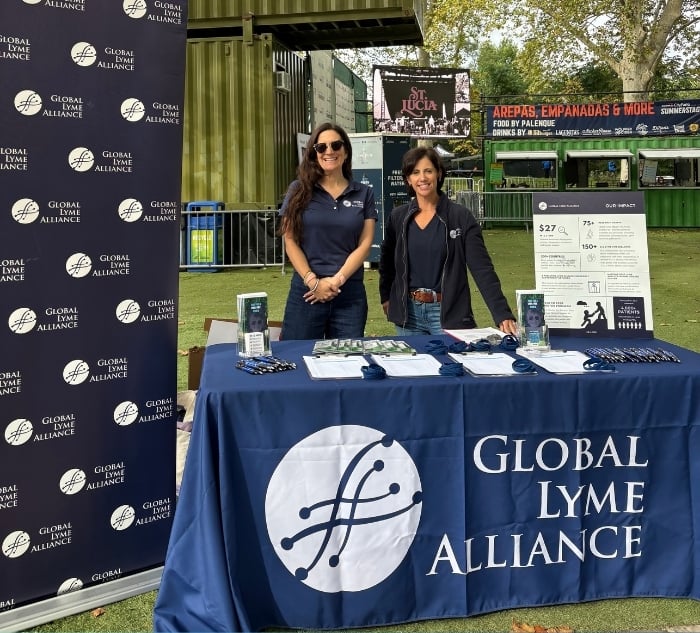
Meet Kristen Harris, director of GLA's Peer-to-Peer Support Program, and learn how this initiative offers vital emotional support for Lyme patients and caregivers.
Have you ever wondered exactly what the Global Lyme Alliance Peer-to-Peer Support Program is and whether you should get involved? Kristen Harris, GLA’s Education and Grant Program Manager who runs GLA’s volunteer programs including the Peer-to-Peer Support Program (also referred to as the Peer Mentor Program) and the GLA Ambassador Program, has the answers. I recently had the opportunity to sit down with Kristen to learn about her and the programs she runs. I left wishing I’d had the Peer Mentor Program when I was at my lowest points with Lyme and other tick-borne illnesses, and feeling so glad this support system now exists for both patients and caregivers.
Kristen feels the same way. A Lyme patient for most of her life, she was likely bitten by a tick at age eight but didn’t experience symptoms until she was a teenager, then relapsed as an adult. She relied on GLA resources for help, showing them to doctors when they were doubting her illness and sending them to friends and family members when they found ticks on themselves or their pets.
Despite cycles of illness, Kristen managed a 15-year career in nonprofit events, fundraising, and volunteer coordination. Before the pandemic, she reached out GLA to volunteer as an Ambassador, wanting to give back to the organization that had assisted her and help spread the word about tick-borne illness. After volunteering for a few years, a position opened up at GLA in 2022 that fit Kristen’s background and skills. “I started as a volunteer, and now I coordinate the volunteers, so it’s really great to be working for the organization that helped me through my journey,” she says.
What is the Peer Mentor Program?
The GLA Peer Mentor program matches one-to-one support for Lyme patients or caregivers. Each patient or caregiver seeking support is matched with a Peer Mentor who has been there before and knows what it’s like. “The journey can be very isolating and lonely,” says Kristen. “Even with the best support team, not a lot of people ‘get it’, per se, because unless you’re living it, it’s hard to fully understand.” Like me, Kristen acknowledges that she was lucky to have the support and resources she did, but “having someone who actually went through it, getting to have a conversation one-to-one with that person, is a different level of support…just having validation from someone saying, ‘I get it, I’ve been there, and I’m here for you.’”
How Does the Peer Mentor Program Work?
Anyone over 18 can join the program as either a mentee or a mentor. If you are a patient seeking support, you can fill out an application that goes into a profile, and an algorithm will match you with a Peer Mentor. You and your Peer Mentor can then message via GLA’s portal or can connect by phone, text, email, or video chat.
Patients or family members who are now “on the other side” can apply to be mentor others. Peer Mentors go through an interview process and a background check and also have a training and orientation to help them run through different scenarios and situations. As part of training, mentors are given resources to point mentees to, from financial resources on the GLA site* to GLA’s provider search engine to additional educational materials about mental health support. Peer Mentors are volunteers, not clinicians or therapists, so while they can’t offer medical advice, they can offer emotional support and practical resources from someone who has walked the path themselves. “Support is essential,” says Kristen, recalling the camaraderie she felt with a fellow patient she sat next to while receiving her first IV infusion. “Sitting next to them in the doctor’s office, it was a different connection than just talking to my mom—who I love dearly—about what I was going through, because she didn’t live it like I did.” She adds that for her, this work is personal. “I have been the person on the other end who is desperate for help.”
Success of the Peer Mentor Program
The Peer Mentor Program has been running for seven years. Since 2022, it has served over 1,300 people. Many are patients, but some are caregivers, particularly mothers who are looking to learn how to advocate for their child or understand their symptoms.
And just as Kristen moved from volunteer to director of the program, some participants have moved from patient to Peer Mentor over time. Kristen remembers one person who came in as a patient a few years ago. “She was very unwell,” Kristen says. But “long story short, she connected with a mentor, found resources, got well, and become a Peer Mentor herself.” Now, in addition to mentoring several patients, she chairs one of the volunteer committees. “She started out looking for a mentor because she was desperate for help, and now she’s helping everybody,” Kristen says proudly.
Kristen’s pride in the program shines in the way she talks about its meaning for her. “I know it sounds cliché,” she says, “but we’re really like family. We’ve had people volunteer in our programs, fall ill again, and feel bad they can’t participate, but we’re here to help them find a doctor, or take care of them in another way.” She adds, “Personally and professionally, this has been super fulfilling because of my own experience.”
How to Get Involved in the Peer Mentor Program
To request a Peer Mentor, click here.
To volunteer as a Peer Mentor, click here.
To learn more about the Peer Mentor Program in general, click here.
Kristen says, “I try to be a resource for all of the programs that I work with at GLA, because I know just how hard this disease can be.” If you know, too, you’d likely make a good match as either a Mentee or a Mentor!
*Note: GLA does not offer financial support to patients, however, it does direct them to foundations and organizations that do.

Jennifer Crystal
Writer
Opinions expressed by contributors are their own. Jennifer Crystal is a writer and educator in Boston. Her work has appeared in local and national publications including Harvard Health Publishing and The Boston Globe. As a GLA columnist for over a decade, her work on GLA.org has received mention in publications such as The New Yorker, weatherchannel.com, CQ Researcher, and ProHealth.com. Jennifer is a patient advocate who has dealt with chronic illness, including Lyme and other tick-borne infections. Her memoir, One Tick Stopped the Clock, was published by Legacy Book Press in 2024. Ten percent of proceeds from the book will go to Global Lyme Alliance. Contact her via email below.