Explore the complexities of Lyme disease diagnosis with insights from Danielle Jonas' experience and learn when to consult your doctor about potential tick-borne illnesses.
When the news broke that Kevin Jonas’ wife Danielle has Lyme disease, the announcement sparked both validation and confusion in the Lyme community. Many people know what it’s like to struggle with seemingly idiopathic symptoms, going from doctor to doctor, being told that they’re just anxious, run down, or stressed. They know how hard Lyme can be to diagnose, and how meaningful it is to finally get that diagnosis when you are in fact suffering from the disease.
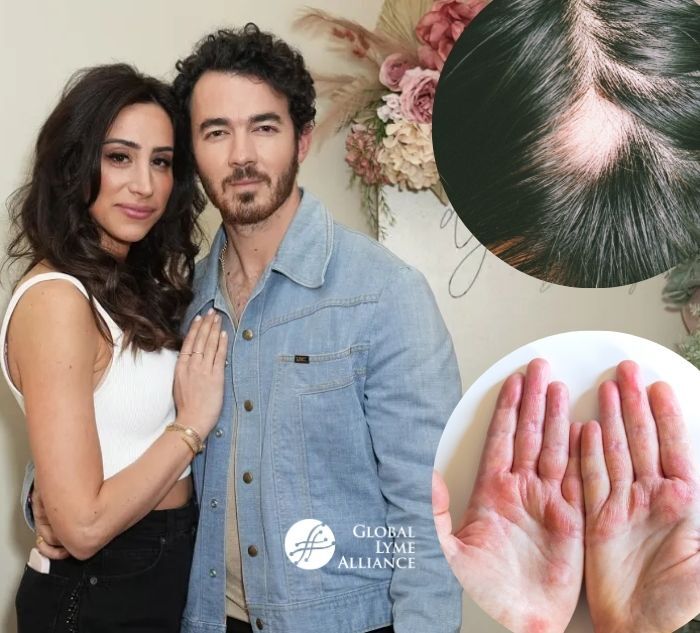
What confused people were Danielle’s symptoms, which on first glance, didn’t seem to point to Lyme. The People Magazine article “Kevin Jonas’ Wife Danielle Jonas Reveals Lyme Disease Diagnosis: ‘They Tried to Tell Me it Was Anxiety” focuses on her symptoms of eczema and hair loss. While neither are considered symptoms of Lyme disease, they can complicate the diagnostic picture. Sometimes, rashes caused by Lyme disease can be mistaken for eczema or other skin conditions, especially if the rash is atypical in shape, location, or color. This overlap can make early recognition of Lyme challenging, so it’s important to consult a healthcare provider if you have unexplained rashes along with other potential Lyme symptoms. It’s also notable that Danielle’s Lyme disease was diagnosed by a punch biopsy, which isn’t a standard diagnostic pathway but is one that, though uncommon, can be used in specific circumstances for direct diagnosis by a specialist.
So yes, Danielle Jonas does have Lyme disease. But if you have eczema, does that mean that you have Lyme, too? Probably not. Let’s walk through some key facts:
- Eczema is not a direct symptom of Lyme disease. If you have eczema in addition to unexplained symptoms that could point to Lyme, then you might want to ask your doctor about tick-borne illness. But eczema alone does not point to Lyme disease.
- Lyme disease rashes have specific qualities, but not everyone gets one. A Lyme rash is called an erythema migrans (EM) rash. It is sometimes a bullseye shape. EM rashes can also present as red circles or ovals or as blotchy marks. Mine was a series of red dots that ran from my wrist to my elbow. Depending on skin tone, EM rashes may have a purple or blue hue. Regardless of shape or color, an EM rash will expand over time, because “migrans” means spreading. If you have a bullseye, you should be immediately treated for Lyme. Other rashes should be examined to see if they are in fact EM rashes. Not everyone who has Lyme disease gets or finds a rash, so don’t rely solely on whether or not you have one. Make sure your doctor also considers your other symptoms and your risk factors too.
- Hair loss is not a direct symptom of Lyme disease. According to the People article, Danielle also experienced hair loss. Hair loss can be caused by a variety of reasons, all of which should be considered by your doctor. My own hair started falling out, possibly as a result of intravenous antibiotics for Lyme.
- Lyme disease is a clinical diagnosis. A licensed medical provider makes a Lyme disease diagnosis based on a patient’s symptoms and risk factors. That diagnosis can be corroborated by blood tests, but given the faultiness of those tests in early disease, they shouldn’t be used alone to determine if someone does or does not have Lyme disease. Other tests such as a punch biopsy or spinal tap can look directly for the Lyme disease bacteria, but they’re invasive and expensive and therefore not commonly used. Lyme cannot be self-diagnosed.
- Only a patient and their doctor fully understand a case. Reactions to Danielle Jonas’ Lyme disease diagnosis are based on the facts presented in the news, but we must remember that only she and her provider know her full story. It isn’t fair to judge anyone’s medical diagnosis, or to try to make one for them, because only they and their doctor understand the whole picture.
When to See a Doctor About Lyme Disease
So, when should you talk to your doctor about Lyme disease? Lyme is sometimes called the “Great Imitator” because symptoms can mirror so many other illnesses, and it can be difficult to diagnose because blood tests only look for antibodies against the Lyme bacterium, Borrelia burgdorferi, not directly for it. You and your doctor should consider Lyme or other tick-borne illnesses if:
- You have an expanding rash
- You have other symptoms of acute or later-stage Lyme disease (for a full list, see “Lyme Disease Symptoms”)
- You had a known tick bite (if possible, save the tick to show a photo to your doctor, or even better, send the tick out for testing)
- You have spent time in a tick-endemic area (that doesn’t mean you have to live there; think about recent and past travel, too!). Ticks can be found in the woods, in bushes and shrubs, on tall grasses including beach dunes, in wood piles, in stone walls, in leaf piles, and in other moist shady areas.
How to Talk to Your Doctor About Lyme Disease
If you suspect you might have Lyme disease, approach your doctor in a collaborative way. Unless you have a documented tick bite and expanding rash, coming into an appointment announcing that you are sure you have Lyme can be off-putting for a provider and might put them on the defensive. Instead, ask if, given your risk factors and symptoms, they think you might have a tick-borne illness. If they suggest testing, consider how long it’s been since your presumed tick bite. Antibodies are very unlikely to show up in the first two weeks of infection. After that, Lyme testing can be taken into greater consideration, but gently remind your provider (again, discuss, rather than tell) that Lyme is a clinical diagnosis that can be corroborated but not solely proven by a blood test.
Lyme can be a difficult diagnosis and, as you know from my years-long story, can be extremely debilitating if not treated early and adequately. I’m glad Danielle Jonas has finally received an accurate diagnosis, and I wish her all the best on her Lyme journey!
***